


In this post, we'll share a summary and insights from the session, Model Customer Data with an Industry Focus, presented at TDX '26.

At Salesforce TDX 2026, Stratus Carta founder and Certified Technical Architect Georgii Saveliev took the stage to unpack one of the most underappreciated challenges in Salesforce Communications Cloud, Media Cloud, and Energy & Utilities Cloud implementations: how do you accurately model a customer when the owner, payer, and user of a service are three different people?
The Salesforce Industries Landscape
Salesforce Industries are verticalized extensions of the foundations set by Sales & Service Cloud, tailor built to the needs of 10+ industry verticals. The Salesforce Industries data models you have access to today are the product of three generations of development and decades of hard-won industry expertise. Their lineage runs through the 2020 Vlocity acquisition, a company built by veterans of Siebel, which pioneered industry-specific CRM configurations for telecoms, insurance, and financial services in the late 1990s and 2000s.
Salesforce offers over a dozen industry-specific clouds, all built on the same Salesforce Platform core. Stratus Carta focuses on three of them, Communications Cloud, Media Cloud, and Energy & Utilities Cloud, which all share a common heritage rooted in the Vlocity acquisition and are now powered by Revenue Cloud. These three verticals are grouped together as CME or Communications, Media, and Energy.
The Limitations of the Standard Model
In Sales & Service Cloud, a customer is typically a straightforward combination of an Account and a Contact, with Assets representing purchased products and Orders capturing transactions. For many businesses, this works well.

The common thread binding these CME customers together is the nature of what they sell: intangible services and product subscriptions. For example, a Telco company sells iPhones, but without the 4G or 5G network, that expensive iPhone 16 Max Pro becomes an iPod with a camera.
To support these services and allow for subscription renewals, the system must address three key elements: "Who Owns the Asset," "Who Paid for the Asset," and "Who Uses the Asset," with the underlying idea that different persons may represent the "who."
Enter the CME Cloud Customer Data Model
The Communications, Media, Energy & Utilities (CME) Cloud introduces a richer set of objects specifically designed to handle these relationships. The model separates the concepts of ownership, payment responsibility, and service delivery into distinct, linkable entities.
B2C vs B2B: Two Flavors of the Same Model
The CME model handles both consumer and enterprise customers, with the key difference being what sits at the top of the account hierarchy. In B2C, the parent is a Consumer Account. In B2B, it's a Business Account which can itself have a parent Business Account, enabling multi-level corporate hierarchies. The Service Account, Billing Account, Asset, and Recipient objects behave identically in both models.
For B2C, we skip Opportunity and Quote and go directly to Orders. Orders have Order Items representing the goods and services being ordered, with Order Item Recipients and optionally their linked Service Account representing the location for which those goods and services are being ordered, and Billing Accounts representing the payers for the goods and services.
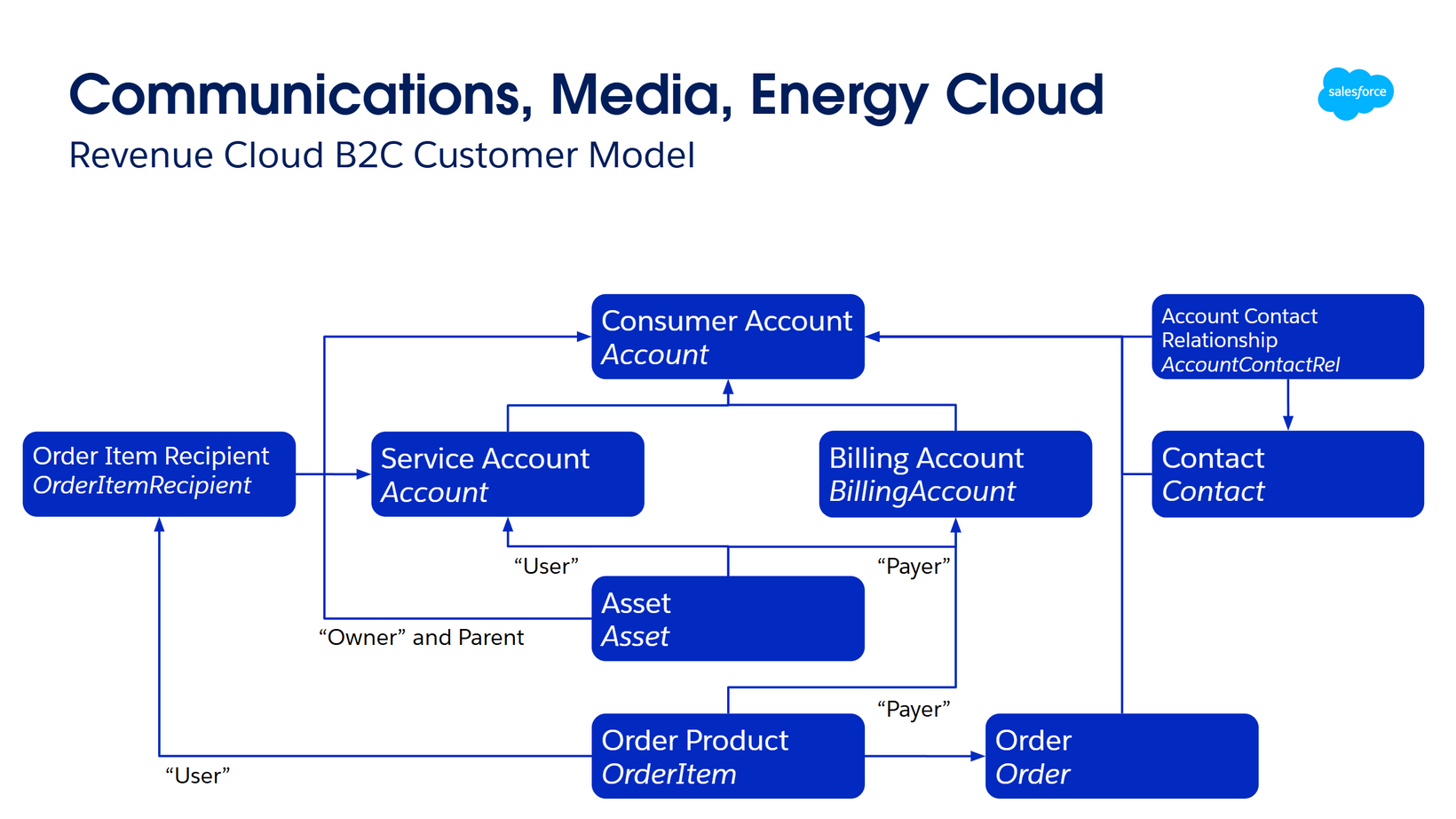
For B2B, we start with an Opportunity and then the configuration happens on the Quote and Quote Line Items (alongside Orders), reflecting the longer sales cycles typical in enterprise deals. Quote Line Item Recipients mirror the Order Item Recipient concept at the quoting stage.

See the Full TDX 2026 Presentation
If you are starting to think this is getting complicated, you are right. Getting this part of your design correct is just as important as getting the product models and pricing correct. After all, you need to understand your customers to be successful.
For this reason, Georgii was selected to present at TDX to help partners and customers alike gain a solid grounding of how this all works, and how to leverage the powerful customer data models of Communications, Media, and Energy & Utilities Clouds.
Watch Georgii walk through the complete customer data model, including live diagrams, the B2C and B2B models, and a working example using fictional family of 4, with several telco services across their apartment in the city and vacation home, with services being billed to a few of the family members.
Recording
Watch the recording on Salesforce+

Slides
TDX26 - Model Customer Data with an Industry Focus.pdfEntity Relationship Diagram (ERD)
View the Entity Relationship Diagram (ERD)